.png)
Trusted Pediatric Hearing Care for Indian Parents
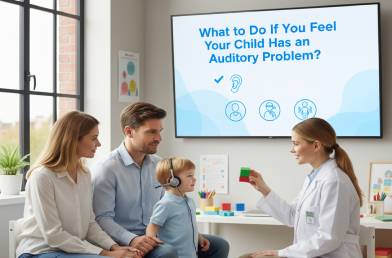
As parents, we closely observe every milestone of our child’s growth. If your child is not responding to sounds, has delayed speech, or struggles to understand instructions, it may raise an important concern:
“Does my child have a hearing or auditory problem?”
At our hearing and ENT clinic, we strongly believe that early detection and timely intervention can change a child’s life. Hearing problems in children are more common than many parents realise—and most are treatable when identified early.
Understanding Auditory Problems in Children
An auditory or hearing problem means difficulty in:
Hearing sounds clearly, or
Processing sounds correctly in the brain
In Indian children, auditory problems may occur due to:
Recurrent ear infections
Excessive earwax
Congenital hearing loss
Complications during birth
Untreated colds, allergies, or adenoid issues
Common Signs of Hearing Problems (Age-Wise)
Infants (0–12 months)
Does not startle to loud sounds
Does not turn toward parents’ voices
Limited or no babbling
Toddlers (1–3 years)
Delayed speech development
Unclear pronunciation
Does not respond when called
School-going Children
Difficulty following classroom instructions
Poor academic performance
Frequently asking “What?”
Turning TV or mobile volume very high
If you notice these signs, do not wait for the problem to resolve on its own.
Step 1: Do Not Delay Medical Evaluation
In India, many parents delay consultation assuming the child will “grow out of it.” Unfortunately, untreated hearing problems can affect:
Speech and language development
Learning ability
Social interaction
Confidence and emotional health
Early diagnosis—especially before the age of 3 years—is critical.
Step 2: Consult a Pediatric ENT or Audiologist
At our clinic, we recommend a complete hearing evaluation using safe and painless tests, such as:
OAE (Otoacoustic Emissions) – for newborns and infants
BERA / ABR – for babies and young children
Pure Tone Audiometry (PTA) – for older children
These tests are non-invasive and child-friendly.
Step 3: Identify Treatable Causes
Many childhood hearing problems are temporary and reversible, including:
Earwax blockage
Middle ear fluid or infection (Otitis Media)
Enlarged adenoids
Allergy-related ear congestion
Early treatment can restore hearing in many cases.
Step 4: Start Treatment or Hearing Support (If Needed)
Depending on diagnosis, treatment may include:
Medicines for infection or inflammation
Minor ENT procedures
Pediatric hearing aids for permanent hearing loss
Auditory training and speech therapy
Pediatric hearing aids are safe, comfortable, and specially designed for children.
Step 5: Speech & Language Therapy for Better Outcomes
Hearing problems often affect speech development. Early speech therapy helps children:
Speak clearly
Improve vocabulary
Perform better in school
Gain confidence in social settings
How Parents Can Support at Home
Indian parents can help by:
Speaking clearly and facing the child
Reducing background noise (TV, mobile, mixer, etc.)
Reading stories aloud in the child’s language
Informing teachers about hearing concerns
Encouraging verbal communication
When Should You Seek Immediate Medical Help?
Visit a doctor urgently if your child:
Suddenly stops responding to sounds
Has frequent ear pain or discharge
Shows regression in speech
Has a family history of hearing loss
Our Clinical Advice to Parents
If you feel your child may have an auditory problem, trust your instincts and act early. Modern hearing tests, treatments, and therapies ensure that most children with hearing difficulties can grow up with normal speech, learning ability, and confidence.
Book a pediatric hearing consultation today to ensure your child’s healthy hearing future.